

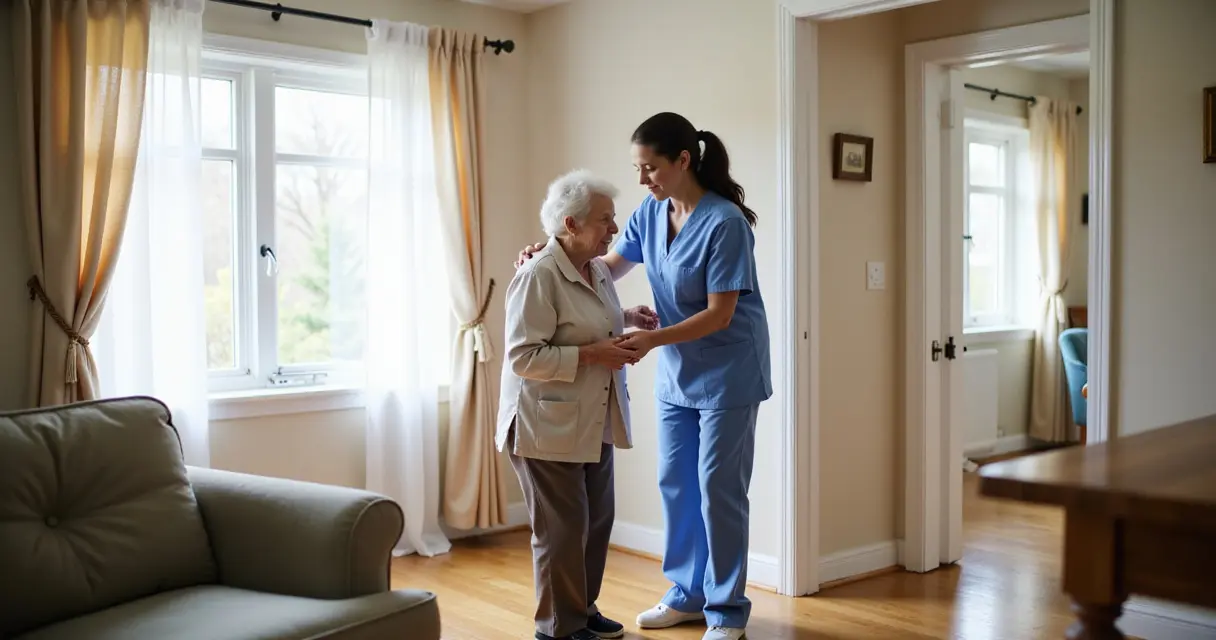
Home health aide work ranks among the fastest growing jobs in the country, since more people need care at home each year. Home health aide training can begin online, at no cost, before you put a dollar into a course or a school.
The old obstacle was money and time. Formal training used to mean paying for a program before you ever got paid for helping anyone.
That is no longer true for the first step. A free online course lets you pick up caregiving basics and safety first, then carry that head start into the hands-on training an agency asks for.
This guide is upfront about what a free course can do. It gives you solid foundations and a certificate of completion, not the state approved training and competency check that a paid caregiving job calls for.
Begin a free home health aide course
Why home health aide training pays off
Demand is the big story. Jobs for home health and personal care aides are projected to grow about 18 percent from 2025 to 2035, far faster than the average for all occupations, according to the U.S. Bureau of Labor Statistics.
For an entry level role, the pay is steady. Home health and personal care aides earned a median wage of 35,800 dollars a year in May 2025, and certified aides or those in specialized care frequently earn more.
Best of all, you do not need a degree. Most aides begin with a high school diploma or less and learn through training on the job, which makes this one of the most accessible doors into healthcare.



It is also a genuine first step. Plenty of aides use the role to move into a CNA or nursing career down the road, with experience already behind them.
Where home health aides work and which jobs pay best
Aides work in clients' homes, in group homes, in hospice, and for home care agencies. The setting shapes the schedule as well as the pay.
Agencies certified by Medicare and Medicaid tend to pay more and offer more stable hours, but they also demand formal training. Specialized care, such as hospice or dementia support, can pay above the base rate.
Certification and a clean background check unlock the better paid positions. That is why the honest path below matters so much.
What a home health aide really does
Aides support clients with daily living: bathing, dressing, meals, getting around, and light housekeeping. Many also check vital signs and remind clients to take their medication.
The job is personal and physical, and it rewards patience and dependability. Good aides become a trusted part of a family, which is why demand keeps climbing.
What certification actually requires
This is the part the "get certified online" ads leave out. A completion certificate shows you studied. It is not the state approved training a certified agency asks for.
The exact rule varies by state and by employer. Some private clients will hire with less, while agencies billing Medicare stick to the federal training standard.
So the honest order is straightforward. Learn the basics for free, then finish the state training and any CPR certification your role calls for.
What "free" really covers, and what it leaves out
Free covers the knowledge. You can learn caregiving basics, safety, and communication without spending anything, and you end up with a certificate that shows initiative.
Free does not pay for the state approved training, the competency check, or CPR certification. The good news is that those steps are often free as well, through an employer or a workforce program.
How online training works, and where it ends
Online training is helpful for the parts that live in your head. You study safety, hygiene, communication, and the basics of care before you ever walk into a home.
Where it ends is hands-on care. No app can teach you to move a client safely, take vital signs, or deal with a real situation inside someone's home.
So think of the free course as step one. It prepares you to start hands-on training already knowing the vocabulary and the safety rules.
The skills you need to learn
- Personal care basics: bathing, dressing, grooming, and moving around safely
- Safety, infection control, and good hygiene habits
- Checking vital signs and basic health observation
- Communication and respect for the client and their family
- CPR and first aid essentials
- How the competency check and state certification work
The best free and low cost resources
These are legitimate places to start. Note that the ones leading to a certified job are often funded or offered by an employer, not a quick online badge.
- Alison: free online caregiving and home health courses that come with a completion certificate.
- CareerOneStop: look up local, WIOA funded aide training close to you.
- Red Cross: CPR and first aid certification, frequently required for the role.
- Employer paid agency training: many home care agencies train new aides at no cost and pay you while you learn.
Does home health aide training really cost nothing? An honest look at the costs
| Step | Typical cost |
|---|---|
| Online foundations course | Free |
| State approved training (around 75 hours) | Often free via an agency or WIOA |
| Competency evaluation | Usually part of the training |
| CPR and first aid certification | Low cost, sometimes paid by the employer |
How long until you can work as a home health aide
The free online foundations take a few days to a few weeks at your own pace. That part depends only on how quickly you work through the course.
The state approved training usually lasts a few weeks, since the federal standard for certified agencies is about 75 hours. Many people are on the job within a month or two.
That speed is a big reason home health aide is such a quick way into healthcare, especially next to longer nursing programs.
The smartest free path: training your employer pays for
If you want the certification without paying for it, look for a home care agency that trains new aides. Many of them cover the state training and pay you as you learn.
Government workforce programs such as WIOA can also pay for training if you qualify. Either way, you land a certified, paid role with no debt.
Use the free online course to get ready for the interview and the training. Showing up with the basics already learned makes you a stronger candidate.
Home health aide or CNA: which one should you pick?
The two are close relatives. A home health aide focuses on care at home, while a certified nursing assistant, or CNA, usually works in a facility and can handle more clinical tasks.
Many people begin as an aide and later train as a CNA for better pay and more options. If that is your plan, read our free CNA and nursing guide next.
Can an online course take the place of hands-on training?
No, and any site that claims it can is not being honest. The classroom portion can happen online, but the care portion cannot. Real hands-on training is a must.
Will employers take your certificate seriously?
As a signal, yes. A completion certificate shows initiative and that you know the basics before your first day.
As a replacement, no. It does not take the place of the state approved training, the competency check, or the CPR certification a certified agency asks for.
Red flags to look out for
- Sites that promise a "certification in days" a state agency will supposedly accept
- Courses that charge you for a state credential they cannot actually issue
- Pages that never bring up hands-on training, the competency check, or CPR
- Badges that say "certified" when all they mean is "watched the video"
Tips to start your caregiving career on the right foot
- Complete the free course and keep your certificate to show initiative
- Ask agencies about paid training before you spend your own money
- Get your CPR and first aid certification early on
- Keep your background check clean, since agencies always run one
- Accept specialized care training when it is offered, for better pay
Your next steps
Start for free, then follow the honest path. For more healthcare and career options, check the high-paying jobs hub and the free CNA and nursing guide.
- Complete a free home health aide or caregiving course to learn the basics
- Look for state approved training through an agency, WIOA, or a community program
- Pass the competency check and earn your CPR and first aid certification
- Apply, open with your certificate, and build experience toward higher pay
Caregiving roles you can start with
Caregiving is a family of roles, and each one suits a different setting. Knowing them helps you focus your training and your job search.
Personal care aide
Personal care aides help with daily living and offer companionship. Some private roles hire with a free course and a background check, which makes this a quick way in.
Certified home health aide
Certified aides work for Medicare agencies and take on more health related tasks. The role requires the state approved training and pays more because of it.
Hospice and specialized aide
Hospice and dementia care call for extra training and pay above the base. They are a strong next step once you have experience and certification.
What to expect in your first days
Your first weeks are about showing you are reliable, safe, and kind. Expect supervision and simpler tasks while you get to know each client and their routine.
A good agency pairs you with an experienced aide at the start. The safety and communication basics from your free course come into play right away, so finishing it pays off.
Arrive on time, follow the care plan, and treat every client with respect. That kind of reputation is what turns a first job into a stable caregiving career.
Frequently asked questions
Can I find a home health aide course for free?
Yes. Sites such as Alison offer free online caregiving courses that come with a certificate of completion. State approved training is a separate step, and it is often free as well.
How much does a home health aide earn?
Home health and personal care aides earned a median of 35,800 dollars a year in May 2025, according to the BLS, and certified or specialized aides often earn more.
Do I need a certification to work as a home health aide?
That depends on your state and your employer. Medicare certified agencies require state approved training plus a competency check, while some private roles ask for less.
How long is the training?
The free foundations take anywhere from days to weeks. State approved training is often about 75 hours, so many people start working within a month or two.
Is there a way to get trained without paying?
Often, yes. Many home care agencies train new aides at no cost and pay you while you learn, and WIOA can pay for training if you qualify.
Are a home health aide and a CNA the same thing?
They are similar, but not identical. An aide focuses on care at home, while a CNA usually works in a facility and handles more clinical tasks. Many aides go on to train as a CNA.
Is CPR certification required?
Often, yes. Many roles ask for CPR and first aid certification, which you can get at low cost from the Red Cross or a similar provider.
Is home health aide a solid long term career?
Yes. It is one of the fastest growing jobs, projected to grow 18 percent through 2035, and it leads clearly to a CNA or nursing career later on.
Is an online course enough to get hired?
It helps as a signal, but most agencies want the state approved training, the competency check, and CPR before they hire.