

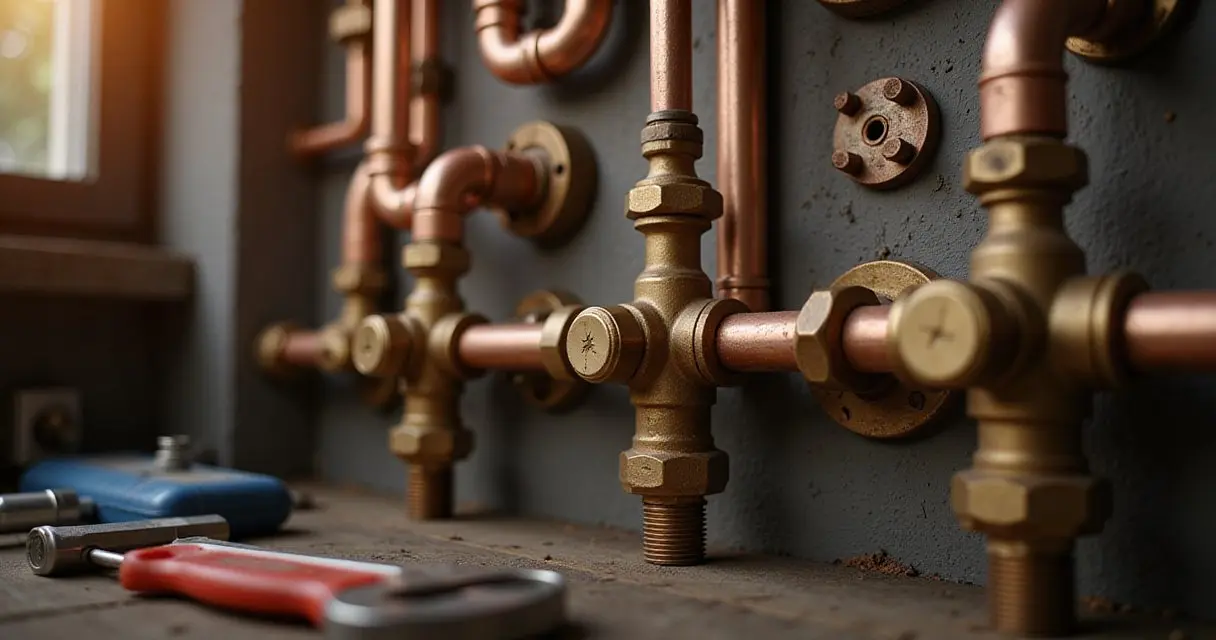
Type free plumbing course with certificate into a search bar and you will see dozens of pages promising a quick road into a six figure trade. A few of those promises hold up. Most do not.
What actually helps you is the truth. A free online course can really teach you the basics, and the completion certificate is a genuine document you can show.
What that certificate cannot do is turn you into a licensed plumber or let you legally repair someone's pipes for money in most of the United States.
Try a real plumbing fundamentals course
Free introduction with a completion certificate, no payment and no obligation.
Plumbing is a regulated trade. The credential that really gets you in is an apprenticeship, and the good part is that you are paid the whole time you are in it.
So treat a free course as a smart first step with no risk. It shows you whether the work suits you before you give it years of your life.
That matters, because plumbing is physical and detailed work. A few free hours on the basics is the cheapest way to learn if it fits you.
This guide shows you what is real, what is marketing, and the exact route from curious beginner to a licensed career.



If you do only one thing today, take a free fundamentals course and see how it feels. Here is a good place to start.
Is a plumbing career really worth it?
Short answer: for many people, yes. The pay is solid, the demand is steady, and you do not finish with a pile of student debt.
According to the U.S. Bureau of Labor Statistics (May 2024), the median pay for plumbers, pipefitters, and steamfitters was $62,970 per year, or about $30.27 an hour.
That figure hides a wide spread. The lowest 10 percent earned under $40,670, while the top 10 percent made more than $105,150 per year.
The top of that range usually goes to master plumbers, specialists, and business owners, not to someone just out of a weekend video course.
Demand looks good as well. BLS projects about 44,000 openings per year over the decade, with roughly 4 percent growth, mostly from workers retiring.
Here is what people tend to overlook: as an apprentice you earn while you learn. You are an employee with a paycheck, not a student paying tuition.
Apprentices usually start at a share of the journeyman wage and get set raises as they move forward, so your pay goes up every year you stay in the program.
Put that next to a four year college route, where you often pay tens of thousands of dollars and earn nothing while you study. The numbers lean strongly toward the trade.
The work is also steadier than many jobs. Pipes burst, water heaters break, and new buildings go up whatever the economy is doing.
The honest truth about free plumbing courses
Let us say this at the start so nothing is unclear later. A free online plumbing course is a way to learn, not a license.
It can teach you the vocabulary, the tools, how pipe systems work, basic plumbing math, and what safe work looks like. That has real value.
It can give you a completion certificate that shows you made an effort, and that is worth mentioning when you apply for an apprenticeship.
It cannot give you a plumbing license. No online course, paid or free, can do that in the states that require one.
It cannot take the place of the supervised hours on the job that licensing boards require. Those hours must be real work under a qualified plumber.
It cannot promise you a job. A certificate makes your application stand out a little, but it is not an offer of employment.
Anyone who says a free certificate is the same as a license or a sure job is either mistaken or trying to sell you something. Keep that in mind.
What it really takes to get a plumbing license
In most states, plumbing is a licensed trade, and the route has a fairly similar shape everywhere even though the details change by location.
At its center is an apprenticeship that usually lasts 4 to 5 years, mixing paid field work with classroom or online technical instruction.
Each year you log roughly 2,000 paid on the job hours, and most states ask for somewhere around 4,000 to 8,000 supervised hours in total before you can test.
Once the hours and the related instruction are done, you take the journeyman exam. Pass it and you are a licensed journeyman plumber.
Later, after more years of experience, you can go for a master plumber license, which often lets you pull permits, run a business, and supervise others.
The classroom or online part that runs next to the field hours covers code, theory, and safety. That is where a free fundamentals course puts you ahead.
The differences between states are real and they matter, so never assume your state works like the one next to it.
What you learn in a free plumbing course
A good intro course will not make you a tradesperson, but it covers the base every plumber builds on. Expect topics like these.
- Tools and materials: the hand and power tools of the trade, plus common pipe materials such as copper, PEX, PVC, and cast iron.
- Pipe and drainage systems: how the water supply and the drain, waste, and vent lines work as one system in a building.
- Safety basics: jobsite hazards, personal protective equipment, and why a safety culture matters in construction.
- Blueprint reading: how to read plans and plumbing symbols so you can follow a job from paper to pipe.
- Plumbing math: measurements, slopes, pipe sizing, and the basic calculations the trade uses every day.
- Codes and standards: a first look at why plumbing codes exist and how they keep people healthy and safe.
Finish knowing this material and you will be a much stronger apprenticeship candidate than someone who arrives with no exposure at all.
The best free and low cost plumbing courses
These are trustworthy places to learn the basics. Each one fits a slightly different stage, so choose based on where you are right now.
| Platform | Cost | Format | Best for |
|---|---|---|---|
| Alison: Introduction to Plumbing | Free, with a free completion certificate | Self paced web course | The best free starting point for complete beginners |
| SkillCat | Free basics, about $10 per month for full access | Mobile app with simulations | Hands on practice and OSHA 10 or EPA 608 prep |
| OSHA Outreach (OSHA 10) | Often free through workforce programs | Web based course | A real safety card that employers value |
| NCCER | Paid, through partner schools | In person training | A nationally recognized industry credential |
| Udemy | Some free, most paid | On demand video | Niche topics and specific skills |
See that the two options with the most professional weight, OSHA 10 and NCCER, are the ones employers recognize. The free certificates are great for learning, not for proving you hold a license.
Can online training take the place of an apprenticeship?
No. It is worth saying that plainly, because a lot of advertising suggests the opposite.
Plumbing is hands on, physical work. You cannot learn to sweat a joint, set a toilet, or clear a stubborn drain from a video alone.
The supervised hours are there for a reason: they protect the public from bad work and build the muscle memory that makes a capable plumber.
A burst pipe behind a finished wall or a badly done gas line is not a minor slip. That is exactly why states require thousands of hours under a qualified plumber.
Do employers accept a free plumbing certificate?
They will see it as a good sign, not as a qualification, and the two are far apart.
When you apply for an apprenticeship, a completion certificate shows you took the first step and already know the basics, which can set you apart from applicants who did nothing.
It does not, however, qualify you to be hired as a working plumber. No employer can legally send you on a job that needs a license you do not have.
The credentials employers really count are an OSHA 10 card, recognized training such as NCCER, and above all your place in a registered apprenticeship.
Look at it from the contractor's side. They need someone dependable, safe on a jobsite, and on a legal track to a license. A certificate points to the first, not the rest.
So go ahead and list your free certificate on your application. Just describe it honestly, as basic learning and not a license.
Step by step: the real road to a plumbing job
This is the route that truly leads to a licensed, paid career, in the order that makes sense.
- 1. Take a free fundamentals course. Learn the basics and make sure you enjoy the work before you invest years.
- 2. Get your OSHA 10 card. It is often free, and it is a credential employers really respect.
- 3. Check your state licensing board. Find out the exact apprenticeship, hour, and exam rules where you live.
- 4. Apply to apprenticeships. Check union programs (such as the UA), nonunion contractor associations, and trade schools near you.
- 5. Spend 4 to 5 years working and learning. Build up your paid supervised hours and finish the technical instruction that goes with them.
- 6. Pass the journeyman exam. This is the license that lets you work on your own as a plumber.
- 7. Think about a master license later. With more experience, it opens the door to leading jobs and running your own business.
Every step on that list is real and within reach. Note that the free course is step one, not the whole journey.
Warning signs to watch for
Because "free plumbing certificate" is a popular search, shady sites gather around it. Save your time and money by spotting these signs.
- Certificate generators. Sites that just print a certificate with no real coursework are worthless and can look dishonest.
- Courses that say they lead to a license. No course hands out a license. If a site says it does, it is not telling the truth.
- Promises that you can "work as a plumber" without an apprenticeship. Where a license is required that is against the law, and acting on it puts you at real risk.
- "Instant lifetime certificate" mills. Fine if you only want to study, but know they carry no professional weight.
- Pressure and upsells. Countdown timers and "limited spots" for a basic online course are sales tricks, not value.
A trustworthy course is clear about what it is. It teaches you real skills and never poses as a license.
What to do next
If plumbing feels like a match, do not overthink the start. Begin small, be honest with yourself, and build momentum.
This week, take a free fundamentals course, get an OSHA 10 card, and look up your state's apprenticeship rules. That is a real plan.
The apprenticeship that comes next is the credential that pays you while you train and leads to a licensed, lasting career. Start with step one below.
Begin with the fundamentals
A free introduction to plumbing with a completion certificate, no cost and no catch.
Frequently asked questions
Is a free online plumbing course worth taking?
Yes, as a way to learn and test your interest. It teaches you the basics and gives you a certificate that shows initiative, but it is not a license or a promise of a job.
Can online training alone make me a plumber?
No. Plumbing requires supervised hands on hours through an apprenticeship. Online training gets you ready for that path, but it cannot replace real work in the field.
Am I a licensed plumber after a free certificate?
No. A completion certificate only shows you finished a course. A license only comes from meeting your state's apprenticeship hours and passing the journeyman exam.
Do employers accept free online plumbing certificates?
They will see it as a good sign when you apply for an apprenticeship, not as a qualification to be hired as a working plumber. Describe it honestly.
How many years does it take to get a plumbing license?
Usually 4 to 5 years through an apprenticeship, mixing paid on the job hours with technical instruction, followed by passing the journeyman licensing exam.
How many apprenticeship hours do I need, and does it change by state?
Yes, it changes. You log roughly 2,000 paid hours a year, and most states require around 4,000 to 8,000 supervised hours in total. Always check with your state board.
Do I need to join a union to become a plumber?
No. Union apprenticeships (such as the UA) are one strong route, but nonunion contractor associations and trade schools also run recognized apprenticeship programs.
How much do plumbers earn, and are apprentices paid?
The median is $62,970 a year (BLS, May 2024), with the top 10 percent above $105,150. And yes, apprentices are paid employees who earn while they learn.